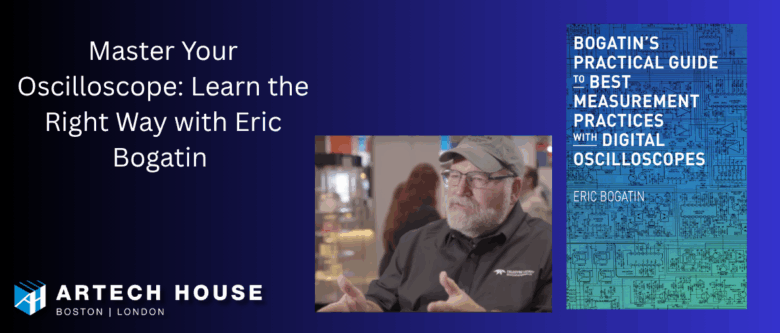
In this interview, we talk to Eric Bogatin, author of the book Bogatin’s Practical Guide to Best Measurement Practices for Digital Oscilloscopes. We discuss the motivation behind writing the book, the target audience, the most useful aspects of the book, the challenges of writing the book, and advice for other engineers who are considering writing a book.
Eric Bogatin is currently a Signal Integrity Evangelist with Teledyne LeCroy and the Dean of the Teledyne LeCroy Signal Integrity Academy, at www.beTheSignal.com. Additionally, he is an Adjunct Professor at the University of Colorado – Boulder in the ECEE dept., and technical editor of the Signal Integrity Journal. He received his Ph.D. in physics from the University of Arizona. He has written six technical books in the field and presented classes and lectures on signal integrity world wide.
1. Could you summarize the main content of your book? What are the key topics addressed?
This book is a practical guide to understanding and using digital oscilloscopes, tailored for both beginner and intermediate engineers. It offers clear explanations of fundamental concepts, hands-on examples, and tips for making accurate measurements in real-world circuits. Whether you’re just starting your engineering journey or need a solid refresher, this book provides a strong foundation in time-domain signal analysis and scope operation. From basic triggering and probe selection to interpreting waveforms and avoiding common pitfalls, it’s an essential reference for any engineer working with electronic signals and looking to build confidence with one of the most important tools on the bench.
2.What is the primary purpose of your book? How do you envision it helping readers in their work or studies?
Primary Purpose of the Book: The primary purpose of my book is to demystify the use of digital oscilloscopes and empower engineers especially beginners and those with intermediate experience to make accurate, confident, and meaningful measurements. Many engineers use oscilloscopes daily without fully understanding their limitations, settings, or the implications of poor probing techniques. This book provides a step-by-step, practical approach to using scopes correctly, avoiding common mistakes, and interpreting signals with confidence.
How It Helps Readers: Readers will gain not just theoretical understanding, but also hands-on skills through examples, visuals, and even a virtual oscilloscope. Whether in school, on the bench, or in debugging a tricky circuit, this book is a toolbox of best practices that turns measurement uncertainty into insight. It’s both a learning resource and a day-to-day reference that sharpens an engineer’s most essential skill seeing what’s really going on in the signal.
3.What sets your book apart from other works in the same field? Are there any innovative concepts, methodologies, or insights that make it stand out?
What Sets This Book Apart: What makes this book unique is its focus on practical measurement techniques rather than oscilloscope theory or specs alone. Most books explain what a scope does—this one teaches you how to use it effectively, in real-world settings, with best practices grounded in engineering intuition and hands-on experience.
Innovative Aspects: It includes step-by-step tutorials paired with video demonstrations, making it a multimedia learning experience. The book integrates a virtual oscilloscope and waveform emulator, allowing readers to experiment and learn without needing hardware. It emphasizes the physics behind good measurement like why probe grounding matters, how transmission lines affect signals, and how to spot artifacts vs. real problems.
The chapters build from foundational skills to advanced diagnostics, with practical checklists, visuals, and examples that readers can immediately apply in labs, classrooms, or product development. It’s not just a guide—it’s a measurement mentor in book form.
4.Who is the intended readership for your book? Are there specific industries, professionals, or fields of study that would benefit most from this content?
This book is intended for engineers, technicians, and students involved in electronic systems, particularly within electrical engineering, embedded systems, RF, and hardware design. It is ideal for entry-level engineers looking to build a solid foundation in oscilloscope use, as well as intermediate engineers aiming to sharpen their measurement skills. Lab instructors and educators will find it a valuable resource for teaching real-world measurement techniques in a structured manner, while technicians and hardware developers working in R&D or manufacturing will benefit from its practical approach to daily oscilloscope use. The book is especially relevant to professionals in industries such as electronics and semiconductor design, telecommunications and RF systems, embedded systems and IoT development, automotive, aerospace, and defense electronics, and test and measurement equipment manufacturing. Anyone working with signal analysis on an oscilloscope will find this guide both practical and immediately applicable to their work.
5. What are the most important lessons or insights you want readers to take away from this book?
The central message of this book is that accurate measurements begin with a deep understanding of the measurement process itself because a digital oscilloscope is only as effective as the engineer using it. One of the most important lessons readers will learn is how to make measurements that truly reflect the behavior of a circuit, rather than artifacts caused by incorrect setup. A key takeaway is the ability to distinguish between real signal behavior and distortions introduced by poor probe usage, inadequate grounding, aliasing, bandwidth limitations, or improper scope settings. The book emphasizes the importance of probe selection and proper setup, showing that even a top-tier oscilloscope can produce misleading results if paired with the wrong probe or connected using a long ground lead. Readers are taught how to connect to circuits in ways that preserve signal integrity. The book also demystifies concepts like bandwidth, rise time, and sample rate—not just by explaining what they are, but by showing how to apply them meaningfully to get accurate, insightful measurements. A recurring theme throughout the book is the discipline of questioning every signal you see. Since every measurement is influenced by the circuit, the probe, and the scope, engineers are encouraged to adopt a critical mindset and ask: “Is this signal real, or is it an artifact?” Finally, the book provides a structured methodology for analyzing unknown waveforms, equipping readers with a process for debugging and interpreting signals using tools like triggering, persistence, averaging, and math functions. By the end, readers won’t just know how to operate an oscilloscope—they’ll know when to trust what it’s showing, and just as importantly, when not to.
6.Does your book include any original research, case studies, or data? If so, could you highlight some of the most significant findings?
Yes, the book includes original case studies, practical experiments, and data-driven insights that are grounded in real-world engineering challenges. While it’s not academic research in the traditional sense, the content is based on firsthand measurements, controlled lab setups, and practical evaluations drawn from years of experience teaching and troubleshooting with oscilloscopes.
Highlights of Original Content: Case Studies on Signal Integrity Mistakes:
The book presents real examples of misleading waveforms such as ringing, overshoot, and noise that were initially interpreted as circuit issues but later revealed to be artifacts of poor probing or incorrect scope settings. Each case includes before-and-after waveforms to show the effect of fixing the measurement setup.
Data from Controlled Experiments: Experiments show how different probe ground lengths, scope bandwidths, or sample rates can dramatically affect what you see on screen. These are backed by side-by-side screenshots and quantified results to reinforce key points. Demonstrations with a Virtual Oscilloscope: Readers can recreate many of the book’s examples using a provided virtual oscilloscope and waveform emulator, allowing them to verify concepts interactively—a unique, hands-on learning element not found in most books.
Comparison of Good vs. Bad Practices: Tables and plots compare signal fidelity under varying conditions (e.g., measuring across a capacitor vs. a resistor, using a differential probe vs. single-ended), helping readers develop intuition based on evidence. These original insights provide a bridge between theory and practice, showing not just how to make measurements, but how to critically evaluate and trust them.
7.Does your book address any new or emerging trends in the field? How does it prepare readers for future developments?
While this book doesn’t aim to predict future technologies or chase trends, it does focus on what matters most today: how to get accurate, reliable measurements using modern digital oscilloscopes.
8.What personal experiences, if any, have shaped your perspective or approach to the topics discussed in your book?
My approach to this book is shaped by over 40 years of hands-on experience in signal integrity, high-speed digital design, and measurement science, along with decades of teaching engineers how to make better measurements. Across my career as an engineer, educator, and author I’ve seen how even experienced professionals struggle with scope measurements not because they lack intelligence, but because they’ve never been taught how to use the tool properly. Influential Personal Experiences:
Teaching thousands of engineers through seminars, webinars, and university courses showed me firsthand the most common misunderstandings about digital oscilloscopes especially the confusion between real signals and artifacts. In writing books like Signal and Power Integrity Simplified and contributing to publications like The Signal Integrity Journal, I’ve focused on explaining complex concepts simply. This same philosophy drives the clarity and accessibility of this book. My work as a technical editor, industry consultant, and professor at the University of Colorado Boulder has reinforced the need for practical, example-driven guidance something missing from many traditional textbooks.
Lastly, I’ve made plenty of my own measurement mistakes, and each one taught me something valuable. This book distills those hard-earned lessons so readers can avoid the same pitfalls and build intuition grounded in real physics, not guesswork.
Ultimately, the book reflects a career-long mission: to help engineers see clearly—both literally on the oscilloscope screen and metaphorically in how they approach every measurement.
Learn more about the book on our websites:
ARTECH HOUSE USA : Bogatin’s Practical Guide to Best Measurement Practices for Digital Oscilloscopes
ARTECH HOUSE U.K.: Bogatin’s Practical Guide to Best Measurement Practices for Digital Oscilloscopes
More Solid State Technology content here: Solid State Technology – Artech House Insider