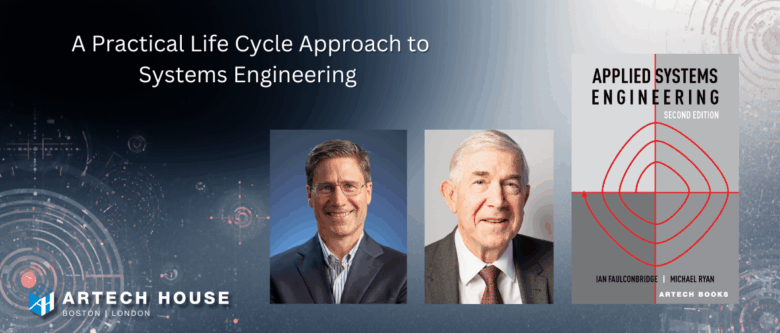
In this interview, we talk to Ian and Mike, authors of the book Applied Systems Engineering, Second Edition. We discuss the motivation behind writing the book, the target audience, the most useful aspects of the book, the challenges of writing the book, and advice for other engineers who are considering writing a book.
1. Could you summarize the main content of your book? What are the key topics addressed?
Applied Systems Engineering, Second Edition is one of three sibling books by the same authors in the Artech House Project Management Series. It provides readers with a complete coverage of the discipline of systems engineering and how it can be applied to the management of complex technical projects. Key topics include:
- A comprehensive introduction to systems engineering and an introduction to requirements engineering.
- Process as applied to a standard lifecycle model concentrating on the early lifecycle phases.
- Management topics applied across the lifecycle to support the systems engineering process.
- Useful coverage of current and historical systems engineering standards.
- Related disciplines concentrating on systems engineering and project management interaction.
- A discussion of different approaches that can be taken to design and development.
- Discussion of toolsets including basic tools through to current model-based digital tools.
The other books in the series include:
- Managing Complex Technical Projects: A Systems Engineering Approach, Second Edition provides readers with an abridged coverage of systems engineering and aims to improve the success rate of complex technical projects by helping readers understand and apply systems engineering in a structured, integrated, and practical way.
- Requirements Practice in Conceptual Design: A Practical Guide, Second Edition focuses in more detail on a requirements-engineering (business-analysis) methodology for early functional design and in doing so provides readers with more detail on this critical element of systems engineering.
2. What is the primary purpose of your book? How do you envision it helping readers in their work or studies?
The book formulates a framework encapsulating the entire systems engineering discipline, clearly showing where the multitude of systems engineering activities fits within the overall effort. The framework provides an ideal vehicle for understanding the complex discipline of systems engineering.
The authors take a top-down approach that introduces the philosophical aspects of the discipline and provides a framework within which the reader can assimilate the associated activities. Without such a reference, the practitioner is left to ponder the plethora of terms, standards and practices that have been developed independently and often lack cohesion, particularly in nomenclature and emphasis. The field of systems engineering is often viewed as dry, detailed, complicated, acronym-intensive and uninteresting. Yet the discipline holds the solution to delivering complex systems on time and within budget and avoiding many of the failures of the past.
The secondary purpose of the book is to describe a complex field in a simple, easily digested manner that is accessible to a wide spectrum of readers, from students to professionals, from novices to experienced practitioners. In line with the top-down approach of systems engineering, the book focuses on the early stages of the system life cycle since the activities in these stages have the greatest impact on the successful acquisition and fielding of a system. The book covers all aspects of the discipline and provides a framework for the consideration of the many issues associated with engineering complex systems.
3. What sets your book apart from other works in the same field? Are there any innovative concepts, methodologies, or insights that make it stand out?
The text contains a useful framework within which to understand systems and systems lifecycles and thence the application of systems engineering activities to the entire lifecycle. The top-down approach introduces the reader to the philosophical aspects of systems engineering and offers an understanding of a plethora of important terms, standards and practices that have been developed independently. It also provides a useful structure for the text to introduce the major issues, methodologies, tools and techniques used in systems engineering.
The text is written for a wide spectrum of readers, from novices to experienced practitioners, and is immediately accessible to any reader interested in systems engineering, avoiding the failures and inefficiencies of past efforts. The text has been written to support undergraduate, postgraduate, and professional education courses, particularly in the distance/virtual mode. This second edition has been developed from a first edition that has been very well received by students.
4. Who is the intended readership for your book? Are there specific industries, professionals, or fields of study that would benefit most from this content?
Applied Systems Engineering is directed at a wide audience and aims to be a valuable reference for all professions associated with the management of complex technical projects. The width and depth of material contained in this book is particularly suited to professionals and practitioners who are relatively new to the discipline of systems engineering and need a complete and relatively comprehensive coverage of the discipline to help with their application. ASE is also well suited to associated professionals such as project managers, systems engineers, quality assurance representatives, integrated logistic support practitioners, and technical specialists.
5. What are the most important lessons or insights you want readers to take away from this book?
Systems engineering is a very useful and very applied engineering discipline that can be applied to a range of different circumstances to help improve the chances of success. However, systems engineering must be appropriately tailored and applied to each situation, should not be considered a “one size fits all” or “cook-book” approach to engineering. The book therefore promotes and encourages independent thought, choice and tailoring on the part of systems engineering practitioners when faced with the unique challenges of applying systems engineering to complex technical projects.
6. Does your book include any original research, case studies, or data? If so, could you highlight some of the most significant findings?
The book uses a well-established framework developed by the authors based on their extensive practical and academic experience with systems engineering. The framework helps readers to contextualise and integrate the myriad of technical and management topics associated with systems engineering. The framework helps readers to understand the many elements of systems engineering and their interrelationships, without which the discipline can appear complex and potentially confusing. Various case studies and examples are threaded through the book to augment the framework in providing an integrated and applied coverage.
7. Does your book address any new or emerging trends in the field? How does it prepare readers for future developments?
Systems engineering is a dynamic discipline. One example is the ongoing refinement and development of industry standards, handbooks and processes used by systems engineers and organizations around the world. Another example is the continued emergence and development of toolsets and approaches including digital engineering and model-based systems engineering. This book aims to be independent of but complimentary to standards, processes and toolsets. To achieve this, the book uses industry standards terminology and uses processes that are compatible with modern systems engineering approaches. Furthermore, the book is unique in that it is in harmony with the most recent standards and handbooks: ISO/IEC/IEEE 15288, ISO/IEEE/IEC 29148, the INCOSE Systems Engineering Handbook, and the INCOSE Needs and Requirements Manual.
8. What personal experiences, if any, have shaped your perspective or approach to the topics discussed in your book?
Collectively, the authors have about 80 years of engineering and project management experience on complex technical projects across several industries and technology domains. Additionally, the authors have years of experience teaching systems engineering to undergraduates, postgraduates and professional development students. Across these years of experience, the authors have seen projects succeed and fail sometimes as a direct result of how systems engineering was or was not applied. What works on one project does not necessarily work on the next. Similarly, experience teaching systems engineering across many years and many student cohorts reveals the most effective ways of communicating systems engineering. These years of experience of applying systems engineering and teaching systems engineering have informed the structure, content and tone of this text.
Learn more about the book on our websites: ARTECH HOUSE USA : Applied Systems Engineering, Second Edition
ARTECH HOUSE U.K.: Applied Systems Engineering, Second Edition
More Project Management content here: Project Management