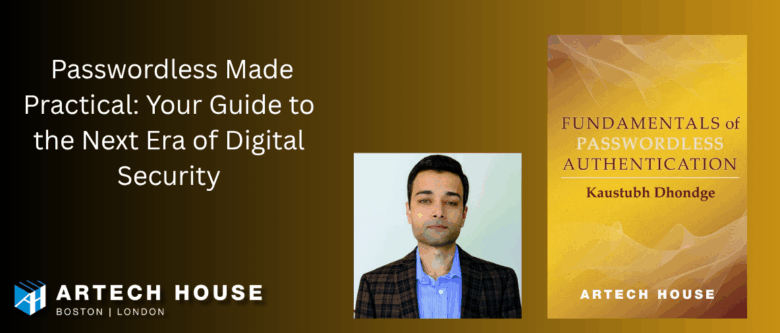
In this interview, we talk to Kaustubh Dhondge, author of the book Fundamentals of Passwordless Authentication. We discuss the motivation behind writing the book, the target audience, the most useful aspects of the book, the challenges of writing the book, and advice for other engineers who are considering writing a book.
Kaustubh Dhondge is the founder of Glaukes Labs. He received his Ph.D. in telecommunication & computer networking and computer science from the University of Missouri, Kansas City.
1. Could you summarize the main content of your book? What are the key topics addressed?
This book offers a comprehensive exploration of passwordless authentication, addressing its technological foundations, design considerations, implementation challenges, and evolving threat landscape. It explores core concepts such as biometrics, cryptographic keys, device-bound credentials, and multi-factor authentication, while also examining architectural patterns, risk-based adaptive systems, privacy implications, and regulatory compliance. The text combines theoretical frameworks with practical insights to help professionals understand and deploy secure, user-friendly passwordless authentication mechanisms.
2.What is the primary purpose of your book? How do you envision it helping readers in their work or studies?
The primary purpose of this book is to bridge the gap between security theory and applied identity management by providing a deep, yet highly accessible, understanding of passwordless authentication. Readers – be they members of the C-suite, security professionals, system architects, or graduate students – will find actionable knowledge to design, assess, and implement secure, scalable, and compliant authentication systems in modern enterprise and cloud environments.
3.What sets your book apart from other works in the same field? Are there any innovative concepts, methodologies, or insights that make it stand out?
What differentiates this book is its end-to-end coverage of the passwordless paradigm – from biometric hardware and secure enclaves to protocols like FIDO2 and WebAuthn – within a cohesive risk and governance framework. The text not only explains technical mechanisms but also addresses real-world deployment strategies, attack vectors, and mitigation techniques, including the role of AI-ML in adaptive authentication. Each concept is tied to practical examples, industry standards, and emerging research, making the book both foundational and forward-looking. The contents have been designed to stay relevant for a long time to come.
4.Who is the intended readership for your book? Are there specific industries, professionals, or fields of study that would benefit most from this content?
The book is targeted at members of the C-suite, cybersecurity practitioners, IAM professionals, enterprise architects, and CISO-level decision-makers, as well as students and researchers in cybersecurity, computer science, and information systems. Industries with stringent security and compliance needs – such as healthcare, finance, critical infrastructure, and cloud services – will find this book especially relevant.
5. What are the most important lessons or insights you want readers to take away from this book?
Key insights include the importance of context-aware authentication, the shift from centralized password stores to distributed, device-bound identity, and the role of usability in security. Readers will gain a nuanced understanding of how to balance security, privacy, and user experience in authentication systems while aligning technological solutions with governance, compliance, and risk management frameworks.
6.Does your book include any original research, case studies, or data? If so, could you highlight some of the most significant findings?
No, but the book does integrate original insights from my academic and applied research in secure IoT systems, mobile platforms, and identity frameworks. It discusses deployment case studies, design blueprints, and implementation patterns drawn from both industry and field research. Notably, it includes examples of biometric attacks, device security breaches, and strategies for mitigating real-world threats using secure enclaves and PAM systems.
7.Does your book address any new or emerging trends in the field? How does it prepare readers for future developments?
Absolutely. The book explores emerging technologies such as post-quantum cryptography, decentralized identity (DID), AI-driven anomaly detection, and the growing use of passkeys and federated authentication. It also examines threats posed by generative AI in phishing and spoofing, and prepares readers to address future challenges with flexible, zero-trust-aligned architectures.
8.What personal experiences, if any, have shaped your perspective or approach to the topics discussed in your book?
My work in both academic and industry environments – ranging from designing authentication systems for smart wearable devices to implementing secure mobile apps – has deeply informed this book. First-hand experience with the limitations of passwords in critical systems inspired me to explore passwordless methods. My collaborations with academic researchers, regulators, security engineers, and developers have shaped a practical and interdisciplinary approach to identity and authentication that’s reflected throughout the book.
Learn more about the book on our websites:
ARTECH HOUSE USA : Fundamentals of Passwordless Authentication
ARTECH HOUSE U.K.: Fundamentals of Passwordless Authentication
More Security and Privacy content here: Security and Privacy – Artech House Insider