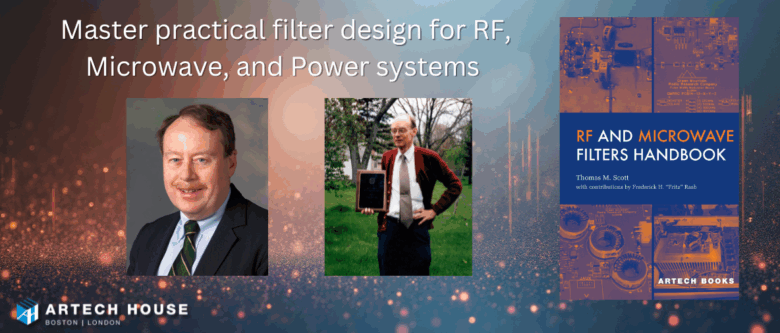
In this interview, we talk to Fritz and Scott, authors of the book RF and Microwave Filters Handbook. We discuss the motivation behind writing the book, the target audience, the most useful aspects of the book, the challenges of writing the book, and advice for other engineers who are considering writing a book.
1. Could you summarize the main content of your book? What are the key topics addressed?
The book begins with a discussion of what can and cannot be realized so that the engineer does not waste time on a design that cannot be realized. Next, it presents the three basic types of filter (Butterworth, Chebyshev, and elliptic). Then it shows how the low-pass designs are transformed to high-pass or band-pass designs. The text then moves to active (op-amp) filters of various types. The constant-delay (Bessel-Thompson) filter is then presented, followed by time-domain responses. Techniques for synthesis and universal filters are then presented. The final chapter summarizes two-port parameters that are used to characterize filters and other networks. Appendices give examples of SPICE simulations, tables of filter parameters, and characteristics of components used to build filters.
2. What is the primary purpose of your book? How do you envision it helping readers in their work or studies?
The objective of this book is therefore to provide the student and practicing engineer with this basic knowledge of analog filters, including inductor-capacitor filters for handling real power and op-amp filters for analog signal processing. This “intermediate-level” knowledge is also the first step in understanding digital filters, microwave filters, and finer points of filter theory.
3. What sets your book apart from other works in the same field? Are there any innovative concepts, methodologies, or insights that make it stand out?
The book is “intermediate level” – neither heavily theoretical nor just nuts and bolts. This is what a practicing engineers needs to be able to move quickly through basic understanding to designing the filter.
4. Who is the intended readership for your book? Are there specific industries, professionals, or fields of study that would benefit most from this content?
The book is intended for use by both practicing engineers and students. It can also be used for a short course.
5. What are the most important lessons or insights you want readers to take away from this book?
The reader should gain a basic understanding of filters and how to design them. This will prepare the reader to design analog filters (both LC and op-amp) and provide background for understanding digital and other types of filters.
6. Does your book include any original research, case studies, or data? If so, could you highlight some of the most significant findings?
This book is about basic principles of filters. While components change over time, the basic principles remain the same.
7. Does your book address any new or emerging trends in the field? How does it prepare readers for future developments?
A reader armed with the knowledge from this book should be able to understand how future developments work.
8. What personal experiences, if any, have shaped your perspective or approach to the topics discussed in your book?
Drawing on years of teaching experience, Dr. Scott has successfully used this material to educate and mentor countless students in the field. Complementing this academic foundation, Dr. Raab has relied on the book as a key reference in his research and development projects, demonstrating its practical value and real-world relevance.
Learn more about the book on our websites: ARTECH HOUSE USA : RF and Microwave Filters Handbook
ARTECH HOUSE U.K.: RF and Microwave Filters Handbook
More MW & RF content here: Microwave and RF Engineering