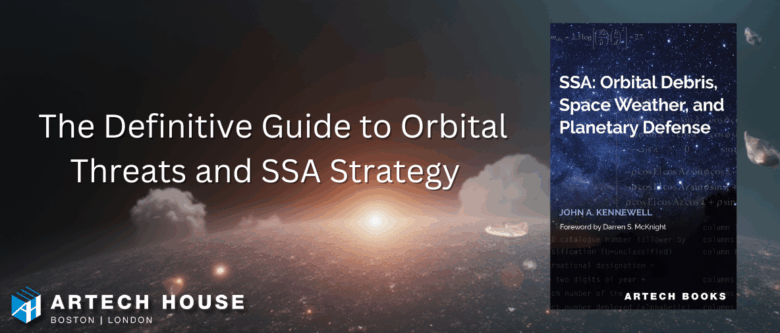
In this interview, we talk to John A. Kennewell, author of the book SSA: Orbital Debris, Space Weather, and Planetary Defense. We discuss the motivation behind writing the book, the target audience, the most useful aspects of the book, the challenges of writing the book, and advice for other engineers who are considering writing a book.
1. Could you summarize the main content of your book? What are the key topics addressed?
The main content of the book concerns the triad of subjects that many feel constitute the field of Space Situational Awareness. These are; Orbital Space Objects, Space Weather and Planetary Defense. These are all comprehensive subjects in themselves. What I have tried to do is give readers an overview of each. Orbital Space Objects, which includes satellites launched into space and the debris created by and through their operations, interactions and degradation forms the largest section of the triad. Space weather, which originates in the Sun and propagates to the Earth orbital environment via electromagnetic energy and structures in the solar wind has the potential to damage operational spacecraft. Solar particle storms and galactic cosmic radiation are very relevant to manned operations in space and may well prove to be a limiting factor in long duration manned missions to the Moon and Mars. Planetary Defense is concerned with the hazard to our near space environment and the Earth from smaller physical bodies (asteroids and comets) that come close to the Earth. There are now known to be over 2000 of these objects that could wreak havoc to the Earth’s inhabitants and out technical systems if they collided with the Earth. A 10 km asteroid is all it would take to send us back into the dark ages, with a debris cloud extending well into the Earth orbital regime and rendering all satellites unusable at least in low Earth orbit (LEO). The explosion of a two megaton nuclear device in LEO would do the same.
2. What is the primary purpose of your book? How do you envision it helping readers in their work or studies?
The primary purpose of the book is to give the reader an overview of the SSA triad. It is obviously not possible to cover any one the three topics in a comprehensive manner. I have tried to give an overview of each and then to provide a more detailed coverage of selected topics in more detail. For the Orbital Space Objects section this has included both collisional theory and also the end of life interactions of LEO debris with the atmosphere as these objects reenter the atmosphere and either burn up or make it back to the Earth’s surface in a modified form.
3. What sets your book apart from other works in the same field? Are there any innovative concepts, methodologies, or insights that make it stand out?
I have tried to give practical examples and examples with mathematical detail to enable the reader to extend their understanding of the concepts discussed.
4. Who is the intended readership for your book? Are there specific industries, professionals, or fields of study that would benefit most from this content?
The intended readership is those who wish to obtain an overview of Space Situational Awareness in its many different facets, with a historical perspective and also a basic grounding in concepts so that they can, for instance, use available data and software to track satellites in Earth orbit, either in a professional capacity, or as an interested layman to view the International Space Station as it moves across their evening sky.
5. What are the most important lessons or insights you want readers to take away from this book?
I am hoping that the overview might allow students to make a choice as to what aspect of SSA interests them enough to continue in further studies either toward a higher degree or toward a chosen career path.
6. Does your book include any original research, case studies, or data? If so, could you highlight some of the most significant findings?
There are certainly case studies in satellite tracking, space debris and reentry along with specific rules developed in space weather prediction. Chapter 9 in particular includes a debris reentry model that I developed.
7. Does your book address any new or emerging trends in the field? How does it prepare readers for future developments?
The last two chapters are devoted to current and future issues in SSA. They include legal and political issues, the very real chance of future wars extending into the space environment, the problems of orbits and communications with operations extending into cislunar space, and the real problem of effective conjunction analysis and collision avoidance with the multiple megaconstellations of objects projected to be launched into LEO in the near future.
8. What personal experiences, if any, have shaped your perspective or approach to the topics discussed in your book?
I have been involved with space activities for most of my life. I can remember watching with excitement the passage of the rocket body that launched Sputnik-1 as it slowly moved across our backyard sky in Melbourne in October 1957. I was extremely disappointed when at the following day’s school assembly there was not even a mention of this historic entry into the space age. I was so excited in talking to my fellow students about this event that I was sent out of the assembly to stand in a classroom where I was later berated by a teacher for disrupting the assembly! One of the first papers I had published was an analysis of the Doppler effect and how it could be used to determine satellite orbits.
My PhD work was on the use of radar to detect meteors and calculate parameters of their orbits, and examine radar sensitivity effects due to galactic noise and even terrestrial vulcanism. I was lucky enough to obtain a post-doctoral fellowship to a University in Florida. During this time I was able to witness the launch of the last Apollo mission to the Moon (Apollo 17), and also the launch of the first crew to the Skylab space station. I spent thirty years working as the Principal Physicist and Australian Manager at the Learmonth Solar Observatory where I was actively involved in monitoring space weather from the Sun and developing prediction tools. At the turn of the century I set up the Australian Space Academy, with a dark sky site of 100 acres to host space ,monitoring facilities in the optical, radio and magnetic domains and a website to introduce diverse space knowledge and concepts to a wide audience.
My involvement with Planetary Defense started in the early years of the current millenium not long after the term was suggested by USAF officer Lindley Johnson, who went on to become the senior NASA officer for Planetary Defense. The hazard to the Earth from near Earth objects was of course known and studied before this time but it was under the name of Project Spaceguard (which originated in a story by Arthur C Clarke). However, it was the name Planetary Defense that caught on. Lately I have been involved in optical near Earth asteroid observations in support of radar measurements made with a bistatic radar where the transmitter is part of the NASA Deep Space Network in Canberra and the receiver is the large CSIRO radio astronomy dish at Parkes.
Learn more about the book on our websites: ARTECH HOUSE USA : SSA: Orbital Debris, Space Weather, and Planetary Defense
ARTECH HOUSE U.K.: SSA: Orbital Debris, Space Weather, and Planetary Defense
More Space Technologies content here: Space Technologies