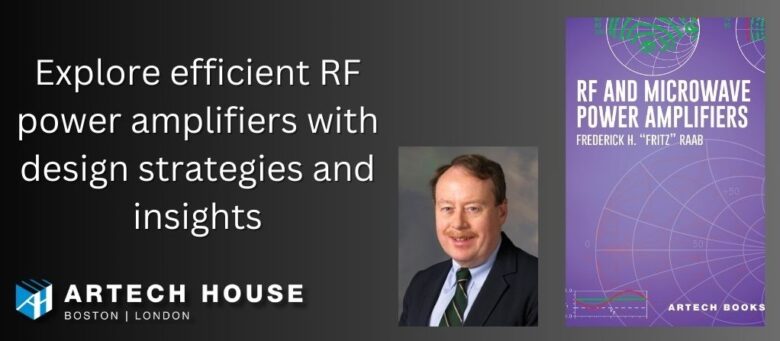
In this interview, we talk to Frederick H. “Fritz” Raab, author of the book RF and Microwave Power Amplifiers. We discuss the motivation behind writing the book, the target audience, the most useful aspects of the book, the challenges of writing the book, and advice for other engineers who are considering writing a book.
Frederick H. Raab is well-known and respected for his expertise in the development of high efficiency power amplifiers and transmitters. He has also been professionally involved with general RF design, antennas, matching networks, communication systems, and signal processing. Graduating from Iowa State University, he received his B.S.(1968), M.S.(1970), and Ph.D. (1972) degrees in electrical engineering. He received the I.S.U. Professional Achievement Citation in Engineering in 1995. was named an IEEE fellow in 2006 and received the Pioneer award from the IEEE MTT Society in 2019.
1. Could you summarize the main content of your book? What are the key topics addressed?
The book describes the working principles of all classes of RF/microwave power amplifiers. This includes various configurations of the basic classes (A, B, C, D, E, and F), as well hybrid classes such as DE and EF. It also presents background information on signals (average efficiency), loads, and RF-power transistors.
2. What is the primary purpose of your book? How do you envision it helping readers in their work or studies?
The purpose of this book is to give the reader a clear understanding of the principles underlying RF power amplifiers, with particular emphasis on efficiency. It is not a nuts-and-bolts cookbook that addresses issues such as which chip capacitor to use. Nor is it an exercise in pure theory. Instead, the principles are presented with due attention to the reality of what can be implemented in practice – and when theory stops and experimentation begins.
3. What sets your book apart from other works in the same field? Are there any innovative concepts, methodologies, or insights that make it stand out?
The book offers a unified, common treatment of the various power amplifiers. This includes not only basic power and efficiency but also average efficiency, effects of mismatched load, and effects of transistor parameters. I have always found it difficult to learn about something when the discussion starts with everything included. So I start with the ideal amplifier, then one-by-one add effects such as saturation resistance and mismatched load. The book is not just theory and derivations; discussions conclude with design equations.
4.Who is the intended readership for your book? Are there specific industries, professionals, or fields of study that would benefit most from this content?
The book is intended for both beginners (students) and experienced practitioners. To bridge this gap, both introductory and advanced material are included. All chapters except the first include problems (and solutions in a separate manual). This allows the book to be used as a text, as a reference, or for self-study. Since equations are presented for most configurations of most of the amplifiers, the book can also be used as a handbook of design formulas.
5. What are the most important lessons or insights you want readers to take away from this book?
The reader should understand that there are many types of power amplifiers and many different issues. The PA that is best suited for one application may not be the best for another application. And the choice may change over time as technology (transistors, digital signal processors, etc.) evolves.
6.Does your book include any original research, case studies, or data? If so, could you highlight some of the most significant findings?
Much of the book is based upon original research that I have done over the years. Some is readily available in publications, some is in hard-to-get publications, and some has not been published previously. In many cases the approach is based upon what I had to do in the lab.
7.Does your book address any new or emerging trends in the field? How does it prepare readers for future developments?
It provides a thorough understanding of PA operation, which is essential to doing research and adapting to new developments. The book also points out limitations in simulators and data sheets, and encourages the reader to experimentally determine the parameters.
8.What personal experiences, if any, have shaped your perspective or approach to the topics discussed in your book?
I started building power amplifiers in high school. As a novice ham-radio operator, I was frustrated that part of the (legally limited) dc-input power became heat instead of signal. This motivated me to look into ways to improve efficiency, In my 50+ years of work in the field, I have worked with most types of PAs, RF power transistors ranging from bipolar to VMOS to LDMOS to GaN, and most PA systems (EER, outphasing, Doherty, and RFPWM systems). My work has been varied and challenging and I have always tried to find the best way to make a new design work.
Learn more about the book on our websites:
ARTECH HOUSE USA : RF and Microwave Power Amplifiers
ARTECH HOUSE U.K.: RF and Microwave Power Amplifiers
More Microwave and RF content here: Microwave and RF – Artech House Insider