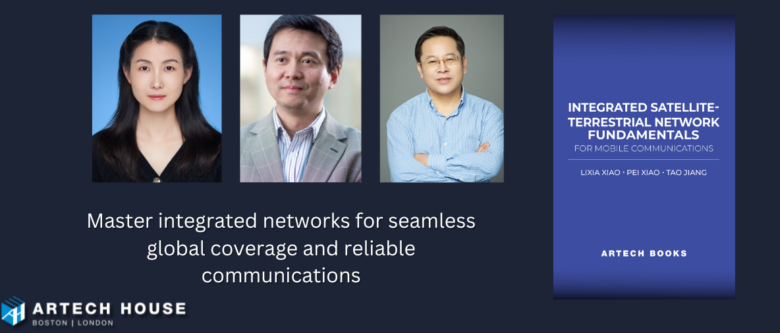
In this interview, we talk to Lixia, Pei and Tao authors of the book Integrated Satellite-Terrestrial Network Fundamentals for Mobile Communications We discuss the motivation behind writing the book, the target audience, the most useful aspects of the book, the challenges of writing the book, and advice for other engineers who are considering writing a book.
1.Could you summarize the main content of your book? What are the key topics addressed?
The book focuses on integrated satellite-terrestrial communication, covering its fundamental concepts, challenges, solutions, and opportunities. It starts with the development of mobile communications, including terrestrial and satellite communication, and then dives into the evolution of integrated satellite-terrestrial communication, such as 5G NR over satellites. Key topics include satellite constellations (definitions, types, design methods), inter-satellite free-space optical communication (fundamentals, key techniques, challenges), channel models (characteristics, classical models, standard evolution), channel coding (classical coding in different communication systems, challenges and solutions in integrated communication), signal modulation (classic and potential modulation waveforms, design guidelines), multiple-antenna technology (antenna types, beamforming techniques in different links), multiple access technology (classic OMA and NOMA schemes, satellite-specific and potential MA for integrated communication), resource and interference management, and mobility management technology.
2.What is the primary purpose of your book? How do you envision it helping readers in their work or studies?
The primary purpose is to provide a comprehensive understanding of the theory and technology of integrated satellite-terrestrial networks. It helps readers gain a solid foundation in the field, enabling them to better understand the concepts, key technologies, and research directions. For researchers, it offers a review of the current research status, open issues, and future development directions, which can guide their research. Industry professionals can use it as a reference to keep up with the latest technologies, which may be beneficial for product development and system design in the satellite-terrestrial communication industry.
3.What sets your book apart from other works in the same field? Are there any innovative concepts, methodologies, or insights that make it stand out?
The existing published books have less introduction to the key technologies of satellite scenes, including a few satellite transmission technologies (such as satellite coding, modulation, and multiple access technology), and the description is relatively general. Unlike existing books, this book more comprehensively integrates the latest research results of various satellite-terrestrial key technologies (including coding, modulation, antenna, multiple access, resource management, interference management, etc.) from the physical layer to the network layer. Further, it makes detailed classifications and descriptions where positioning is more targeted and innovative.
4.Who is the intended readership for your book? Are there specific industries, professionals, or fields of study that would benefit most from this content?
The intended readership includes students studying communication-related fields, such as telecommunications engineering and wireless communication. Researchers in the satellite-terrestrial communication field can benefit from the in-depth exploration of various technologies. Industry professionals, including those involved in satellite system design, mobile network development, and communication equipment manufacturing, can use it to update their knowledge and gain insights for practical applications.
5.What are the most important lessons or insights you want readers to take away from this book?
Readers should understand that integrated satellite-terrestrial communication is an inevitable trend in the future of communication. They need to be aware of the complex challenges in this field, such as huge differences in channel environment, limited satellite network element platform capabilities, and high-speed dynamic changes in network topology. Also, they should learn about the various key technologies and potential solutions to these challenges, and how different technologies can be integrated to achieve seamless global coverage and high-quality communication services.
6.Does your book include any original research, case studies, or data? If so, could you highlight some of the most significant findings?
The book includes original research and case studies that provide in-depth analysis of various aspects of integrated satellite-terrestrial communication. For example, channel coding in Chapter 6 and Inter-satellite resource management in Chapter 10 are both the original research, and relevant content have been published in IEEE Wireless Communications [1]and IEEE Vehicular Technology Magazine [2], respectively.
[1] Yangyang Liu, Lixia Xiao, Weidan Liu, Zhongxiu Feng, and Tao Jiang. Channel Coding for Satellite-Terrestrial Integrated Communication: Classic Applications, Key Technologies, and Challenges. IEEE Wireless Communications. vol. 31, no. 3, PP:348-354, Jun. 2024.
[2] Zhuang Yao, Jiaxi Zhou, Lixia Xiao, Mingjie Feng, Pei Xiao, and Tao Jiang. LEO Inter-Satellite Communications: From Routing to Resource Allocation. Appear to IEEE Vehicular Technology Magazine. DOI: 10.1109/MVT.2025.3530393
7.Does your book address any new or emerging trends in the field? How does it prepare readers for future developments?
We mostly discuss some possible challenge in each chapter of key technologies, which equips readers with knowledge about the limitations of emerging technologies, enabling them to anticipate problems and work on solutions in future research or professional work, thus preparing them for future developments in the field.
8.What personal experiences, if any, have shaped your perspective or approach to the topics discussed in your book?
Having spent nearly 10 years in the field of information and communications engineering, my journey has been marked by a deep passion for exploring the frontiers of technology and a commitment to addressing real-world challenges. My involvement in nearly a hundred research papers and dozens of projects has provided me with a unique perspective on the evolution and integration of satellite and terrestrial communication systems. One of the key experiences that has shaped my approach is my early work on satellite communication projects, where I witnessed firsthand the limitations of traditional satellite networks in providing seamless coverage and high-speed connectivity. This experience led me to question the status quo and explore innovative solutions that could bridge the gap between satellite and terrestrial systems. Throughout my career, I have been fortunate to collaborate with a diverse range of professionals, from engineers and researchers to policymakers and industry leaders. These interactions have broadened my understanding of the multifaceted challenges in the field, such as the need for efficient resource management, the impact of environmental factors on signal transmission, and the importance of standardized protocols for interoperability. Moreover, my role as a professor has given me the opportunity to mentor and guide the next generation of researchers and engineers. This has reinforced my belief in the importance of knowledge sharing and collaboration to drive innovation and solve complex problems.
In writing this book, I have drawn upon my personal experiences and insights to provide a comprehensive and forward-looking perspective on integrated satellite-terrestrial communication. I hope that my journey and the lessons I have learned along the way will inspire readers to embrace the challenges and opportunities in this exciting field.
Lixia Xiao is currently a Professor in the School of Cyber Science and Engineering, Huazhong University of Science and Technology, Wuhan, P. R. China. She received the B.E., M.E., and Ph.D. degrees from the UESTC in 2010, 2013, and 2017, Respectively. From 2016 to 2017, she was a visiting student with the School of Electronics and Computer Science, University of Southampton. From 2018 to 2020, she has been a research fellow with the Department of Electrical Electronic Engineering, University of Surrey. Her research interests mainly focus on physical layer transmission techniques for integrated satellite-terrestrial communications, including waveform design, multi-antenna technique design, multiple access design etc. She has authored or co-authored more than 100 technical papers. She is served as associate editor of some technical journals in communications, including IEEE Network, IEEE Internet of Things Journal, Digital Communications and Networks, China Communications, etc.
Pei Xiao is a Professor in Wireless Communications in the Institute for Communication Systems (ICS) at the University of Surrey. He is currently the technical manager of 5GIC/6GIC, and leads the research team in the new physical layer work area, and coordinates/supervises research activities across all the work areas. His main research interests and expertise span a wide range of areas in communications theory and signal processing for wireless communications. His recent research has extensively explored non-terrestrial networks (NTN) and satellite communications, which are crucial for integrating satellite systems into 5G and future 6G networks. His work has addressed significant challenges in energy-efficient communication, security, and waveform optimization for NTN, contributing to the development of robust and efficient satellite communication systems.
Learn more about the book on our websites:
ARTECH HOUSE USA : Integrated Satellite-Terrestrial Network Fundamentals for Mobile Communications
ARTECH HOUSE U.K.: Integrated Satellite-Terrestrial Network Fundamentals for Mobile Communications
More Communications content here: Communications – Artech House Insider