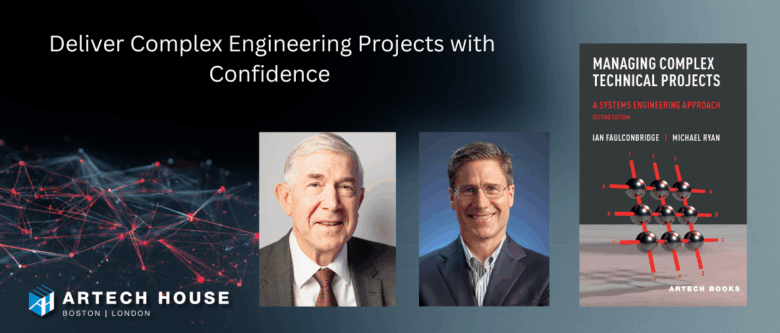
In this interview, we talk to Ian and Mike, authors of the book Managing Complex Technical Projects: A Systems Engineering Approach, Second Edition. We discuss the motivation behind writing the book, the target audience, the most useful aspects of the book, the challenges of writing the book, and advice for other engineers who are considering writing a book.
1. Could you summarize the main content of your book? What are the key topics addressed?
Managing Complex Technical Projects: A Systems Engineering Approach, Second Edition is one of three sibling books by the same authors in the Artech House Project Management Series. The book provides a comprehensive, lifecycle-based treatment of managing complex technical projects, with a particular emphasis on systems engineering as the integrative discipline that enables project success. It addresses how complex systems are conceived, defined, designed, developed, integrated, and delivered, focusing on the processes that link diverse disciplines into a coherent whole.
Key topics include:
- The nature of complexity in modern technical projects.
- Systems engineering principles and philosophy.
- Requirements definition and management.
- Functional and physical architectures.
- System decomposition, integration, and validation.
- Lifecycle planning and documentation.
- Systems engineering management.
- Common systems engineering tools and techniques.
- Interfaces between systems engineering and related disciplines (project management, quality, logistics, specialist engineering).
- Comparative discussion of development approaches (waterfall, incremental, evolutionary, spiral, and Agile).
The other books in the series include:
- Applied Systems Engineering, Second Edition provides readers with a deeper coverage of the systems engineering discipline and aims to equip readers with the knowledge required to apply systems engineering successfully to different technical projects.
- Requirements Practice in Conceptual Design: A Practical Guide, Second Edition focuses in more detail on a requirements-engineering (business-analysis) methodology for early functional design and in doing so provides readers with more detail on this critical element of systems engineering.
2. What is the primary purpose of your book? How do you envision it helping readers in their work or studies?
The primary purpose of the book is to improve the success rate of complex technical projects by helping readers understand and apply systems engineering in a structured, integrated, and practical way. Rather than focusing on isolated disciplines, the book emphasizes how those disciplines must work together across the system lifecycle.
The book is intended to help readers:
- Understand the contribution of systems engineering to project management.
- Understand where individual activities fit within the overall systems engineering effort.
- Make informed decisions during the early lifecycle stages, where project outcomes are most strongly influenced.
- Avoid common causes of project failure related to poor integration, unclear requirements, and fragmented processes.
- Develop independent judgment in tailoring systems engineering approaches to specific projects.
This book focuses on the contribution of systems engineering in support of project management. Readers seeking further detail regarding systems engineering activities, processes, and tools are able to refer to the sibling books by the same authors in the Artech House Project Management Series: Applied Systems Engineering, Second Edition
3. What sets your book apart from other works in the same field? Are there any innovative concepts, methodologies, or insights that make it stand out?
What sets this book apart is its explicit focus on integration and coherence. Rather than presenting systems engineering as a collection of disconnected tools, standards, or acronyms, the book provides a unifying framework that shows how all activities relate to one another across the system lifecycle.
Distinctive features include:
- A top-down, framework-driven approach that anchors detailed practices in overarching principles.
- Emphasis on early lifecycle activities, where leverage over cost, schedule, and performance is greatest.
- A deliberate effort to demystify systems engineering, countering its reputation as dry, overly complex, or inaccessible.
- Balanced treatment of philosophy, process, management, and tools, rather than over-emphasizing any single aspect.
- Clear positioning of systems engineering as the means by which complex projects are managed, not merely an engineering sub-discipline.
4. Who is the intended readership for your book? Are there specific industries, professionals, or fields of study that would benefit most from this content?
The book is written for a broad, multidisciplinary audience involved in the management or delivery of complex technical systems. It is deliberately accessible to both newcomers and experienced practitioners.
Intended readers include:
- Project managers
- Systems engineers
- Engineering managers
- Business analysts
- Quality assurance professionals
- Integrated logistics support practitioners
- Maintenance and sustainment professionals
- University students studying engineering, project management, or systems disciplines
The content is applicable across industries such as aerospace, defence, transportation, communications, infrastructure, and other sectors where large, complex systems are developed and delivered.
5. What are the most important lessons or insights you want readers to take away from this book?
The most important insights the book aims to convey are:
- Disciplinary excellence alone is not sufficient for project success—effective integration is essential.
- Systems engineering provides the structure and processes needed to manage complexity across the full lifecycle, from cradle to grave (not just in acquisition).
- Early lifecycle decisions have disproportionate impact on cost, schedule, and performance outcomes.
- There is no single “correct” systems engineering solution—tailoring and independent thinking are essential.
- A clear framework enables practitioners to navigate standards, tools, and terminology without being overwhelmed.
Ultimately, the book seeks to equip readers with both understanding and judgment, enabling them to manage complex technical projects more effectively and avoid the systemic failures that have become all too common.
6. Does your book include any original research, case studies, or data? If so, could you highlight some of the most significant findings?
The book uses a well-established framework developed by the authors based on their extensive practical and academic experience with systems engineering. The framework helps readers to contextualise and integrate the myriad of technical and management topics associated with systems engineering. The framework helps readers to understand the many elements of systems engineering and their interrelationships, without which the discipline can appear complex and potentially confusing. Various case studies and examples are threaded through the book to augment the framework in providing an integrated and applied coverage.
7. Does your book address any new or emerging trends in the field? How does it prepare readers for future developments?
This book is independent of but complimentary to standards, processes and toolsets. To achieve this, the book uses industry standards terminology and uses processes that are compatible with modern systems engineering approaches. The book is unique in that it is in harmony with the most recent standards and handbooks: ISO/IEC/IEEE 15288, ISO/IEEE/IEC 29148, the INCOSE Systems Engineering Handbook, and the INCOSE Needs and Requirements Manual.
8. What personal experiences, if any, have shaped your perspective or approach to the topics discussed in your book?
Collectively, the authors bring over 80 years of engineering and project management experience gained on complex technical projects across multiple industries and technology domains. In addition, they have extensive experience teaching systems engineering to undergraduate, postgraduate, and professional-development audiences.
Across this combined professional and educational experience, the authors have observed projects that have both succeeded and failed—often as a direct consequence of how systems engineering was, or was not, applied. They have also learned that approaches effective on one project do not necessarily translate to another, and that systems engineering must always be applied thoughtfully and contextually rather than prescriptively.
Similarly, many years of teaching systems engineering to diverse cohorts have revealed the most effective ways of communicating what is often perceived as a complex and abstract discipline. Together, these experiences—both in practice and in the classroom—have directly informed the structure, content, and tone of this text.
Learn more about the book on our websites: ARTECH HOUSE USA : Managing Complex Technical Projects: A Systems Engineering Approach, Second Edition
More Project Management content here: Project Management