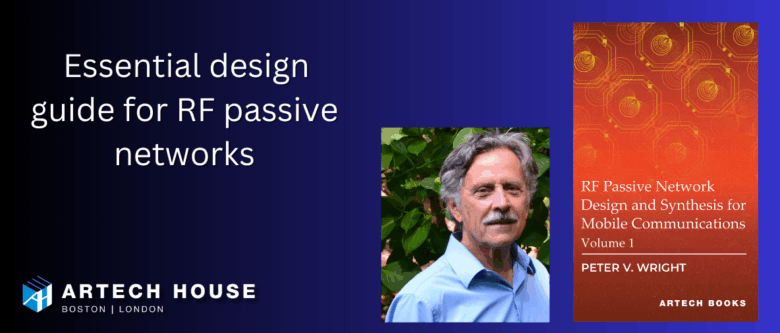
In this interview, we talk to Peter Wright, author of the book RF Passive Network Design and Synthesis for Mobile Communications – Volume 1. We discuss the motivation behind writing the book, the target audience, the most useful aspects of the book, the challenges of writing the book, and advice for other engineers who are considering writing a book.
1. Could you summarize the main content of your book? What are the key topics addressed?
The book is intended as an aid to the practicing engineer in the design and modeling of various passive circuit elements, which are critical to the design of modern RF communications modules. The particular focus is on RF couplers, combiners, splitters, and cellular power amplifiers. In the first chapters, the reader is introduced to the basic analytical tools essential to modeling passive RF circuit topologies. Depending on the number of external circuit nodes and terminations, there may be multiple options for analysis, so the designer must decide which one is most appropriate. To this end, relationships between various alternate parametric representations are explored. The utility, limitations, and advantages of each are discussed. Power transfer expressions for each set of parameters are developed.
The basis of all passive RF circuits are passive components, namely, inductors, capacitors, and resistors. Unfortunately, none of these components exist in their idealized form. In practice, each has associated parasitics that must be accounted for in any useful circuit design. How to best include these parasitics in useful lumped-element models, and how to extract the parasitic elements from measured bench data is presented in detail.
Nowadays, Computer Aided Design (CAD) software suites are essential to the modeling and laying out of a complex RF module. However, they are extremely expensive and not very user-friendly for quickly exploring the tradeoffs between multiple circuit topologies that might be useful for meeting specified design parameters. One chapter of the book, teaches how Excel can be used for complex passive RF circuit modeling with a graphical interface that morphs instantly with a change in input parameters. The approach followed is based on using the lumped-element models, incorporating all important parasitics, to obtain analytically-derived closed-form expressions for the behaviour of the network. These solutions, which can be instantly updated with changing inputs, typically give greater insight into the behaviour of a network than is obtained by simply trying to optimize the performance of a network in an EM software simulation program. Having created such worksheets, they can be widely used across an organization at essentially no cost. Optimal circuit topologies identified by such an approach can then be used as the basis for a full final CAD design.
The book includes several chapters on the design of matching, filter and coupler networks. Particular emphasis is given to the design of Power Amplifier (PA) output matching and combining architectures. Detailed analytic design equations are provided for each of the networks, which can be applied to the synthesis and analysis of the networks. Extensive examples are given, demonstrating the key characteristics of each of the networks. The advantages and disadvantages of single-phase versus multi-phase PA combining architectures are discussed. Also, the performance characteristics of coupled-inductor elements are explored in great detail.
2. What is the primary purpose of your book? How do you envision it helping readers in their work or studies?
The primary purpose of this book, is to help the practicing RF engineer quickly evaluate which RF architecture would be most appropriate for achieving a set of target specifications. The optimum choice will inevitably involve a compromise between size, performance, and cost.
First, what this book is not; it is not intended to replace the need for a full CAD 3D analysis and layout of an RF module. Second, what it is; it is intended to empower the RF designer to quickly evaluate alternate circuit architectures in the initial stages of a design. The basis of the approach is to create circuit models, employing lumped-element models and their associated parasitics. Based on these models, analytical closed-form expressions are derived that accurately characterize the key performance parameters of the network. These solutions, can easily be programmed in any common software tool of the designer’s preference. The capabilities and limitations of alternate architectures can thereby be fully comprehended before embarking on a lengthy CAD optimization. All the parametric plots for the design examples in the book were actually programmed in Excel. The latter is universally available, so essentially low-to-no cost to run, and has the capability to update circuit diagrams and parametric plots instantly in response to changing inputs. The instant visual user feedback provides with an intuitive insight into the behavior of a network to a greater extent than is possible from optimizing the network in a CAD program.
3. What sets your book apart from other works in the same field? Are there any innovative concepts, methodologies, or insights that make it stand out?
Mobile communications devices exchange information with external units via an RF interface. The RF section in the device is responsible for both transmitting and receiving RF transmissions. The RF modules designed to carry out these functions comprise both active and passive components. Since battery life is critical to a mobile device high efficiency is paramount to their design. Small size is also critical in a mobile device, as is cost. The focus of this book is to provide the engineer with a comprehensive set of tools that will allow them to quickly and easily implement any of the passive elements required in an RF module.
Many of the fundamental circuit architectures for passive RF couplers, combiners, splitters, and filters were conceived during World War II. However, by modern standards, the implementations were bulky, largely relying on waveguide structures. Later, the waveguides were replaced with microstrip lines on ceramic with discrete capacitors and inductors. But these were expensive and still relatively large. The majority of today’s mobile devices, are implemented on low-cost multi-layer laminates, passive glass or silicon wafers. Using such construction, inductive elements can be implemented not as discrete elements, but integrated directly into the substrate carrier. The multi-level construction permits arbitrary inductor values and well-defined mutual-inductor coupling to be easily realized.
This book focuses efficient design approaches for the most critical passive elements that can be readily implemented with the new construction techniques. It is intended as a comprehensive designer reference for the practical RF designer. With the numerous design examples given, the reader can quickly compare the performance tradeoffs between various circuit options. An in-depth review of PA circuit architectures and combining networks is provided. In addition, the book examines the principal performance characteristics of single-ended and multi-phase PA architectures.
4. Who is the intended readership of this book? Are there specific industries, professionals, or fields of study that would benefit most from this content?
This book is intended to be read by practicing RF engineers, or those at university currently studying to become RF design engineers. It thoroughly covers the mathematical circuit analysis approaches necessary to design passive RF elements. It also introduces the reader to all the basic RF component architectures common in an RF module. The formulae provided, should enable the reader to quickly design any of the multiple RF circuits covered with minimal effort, required to meet a set of desired specifications.
The book also illustrates how the formulae given can be easily incorporated into a software implementation of the user’s choice to realize a useful and low-cost RF design tool. All the circuit performance graphics in the book were actually implemented in Excel.
5. What are the most important lessons or insights you want readers to take away from this book?
A former professor of mine once said “If you cannot write the equations to predict a physical phenomenon, you don’t understand it.” I have to agree with him. Although, I would have to add unfortunately, I’m not sure the inverse is exactly true. Knowing Maxwell’s equations does not provide a deep physical insight into electromagnetism.
I would hope the reader will take away from this book that a basic understanding of the key mathematical design and performance characteristics of a network is critical to effective design. Under the constraint of time-pressure, commonly, RF engineers will approach a new design seeking to “leverage” an existing circuit design to meet the new requirements. With the advanced CAD tools, this may consist of simply adding a few components to an existing design and letting the software re-optimize the circuit. This approach frees the engineer from having to spend time on any basic circuit analysis or having to consider any new fundamentally different circuit topologies that might be advantageous. Unfortunately, this design approach does not guarantee that the resulting solution is optimal for the requirements. To achieve a more optimal solution, would require alternate circuit topologies to be built and evaluated in the CAD tool. However, time constraints usually preclude this course of action.
A principal objective of this book is to detail how simple analytic design approaches can be used for rapid design optimization and design of RF circuits. Formulae, algorithms, and analysis and data display techniques are presented for use by the practicing RF design engineer. Not only do these techniques allow for a rapid comparison to be made of the performance of alternate RF circuit topologies, they also impart to the designer a deeper understanding of the critical design trade-offs that can be made for each topology. The preferred configuration identified in this way, can then be entered into a CAD tool for final optimization.
The use of analytic solutions for RF circuit design has fallen out of favor in recent times as design engineers have increasingly shied away from writing equations and performing detailed circuit analysis. Instead, designers have become increasingly dependent on software packages to do the circuit design and optimization for them. This book is an attempt to change that by providing techniques that are relatively simple to apply and can help the designer become more creative by exploring circuit innovations that might otherwise have been time-prohibitive to consider.
Having a user-friendly modeling tool, based on simplified analytic solutions, with instant visual feedback, can greatly aid in initial design design. While expensive CAD design tools are essential for final device optimization and layout, they are very time consuming and do not propose alternate circuit topologies might give better results. The formulae, simulation modeling, and design examples given in this book are meant to meet this need.
6. Does your book include any original research, cases studies or data? If so, could you highlight some of the most significant findings?
The design formulae and modeling approaches presented in the book have been used in the design of many RF communications modules, particularly for couplers, PA output matching networks and filters. One aspect key to significantly improving the performance of many of these networks is the exploitation of mutual inductor coupling. Low-frequency transformers are perhaps the most widely-known components that depend uniquely on energy transfer via magnetic coupling. However, in the GHz domain, almost exclusively used by today’s mobile communications devices, the low-frequency concepts of a transformer are no longer valid, and instead, they must be viewed and modeled as a pair of coupled inductors. This has significant implications for the design of both single-phase and multi-phase PA designs.
Traditionally, a coupled-inductor architecture has been been the default option for combining the outputs of two differential PAs. This likely originates from the assumption that an RF inductor pair has similar characteristics to a low-frequency transformer. However, as demonstrated by example, in the book, this is not the case, and frequently alternate combiner architectures can achieve much superior performance. The analyses reveal that relying solely on magnetic coupling for energy transfer through a combining network will generally result in poorer performance than a combining network that additionally includes a path for direct electrical coupling.
Many examples are given in the book, of network configurations that transfer RF energy by a combination of both magnetic and electrical coupling. Such configurations are shown to be advantageous in both multi-phase and single-phase designs. Typically, they exhibit lower loss, across wider bandwidths, than architectures that rely solely on electrical or magnetic coupling.
7. Does your book address any new or emerging trends in the field? How does it prepare readers for future developments?
By furnishing the reader with a solid background in the fundamentals of RF passive network design, they should be well-prepared for applying to design new and innovative structures in future designs. The chapter on lattice combiner/splitter module design is especially important in this respect. The three-port configurations discussed, offer wide-ranging design possibilities that to-date have been largely underappreciated and found only infrequent use in RF module designs. The chapter proposes novel design and implementation approaches for this class of three-port networks. They can be employed as output combiners in multi-phase PA configurations, including those that are either balanced or differential. When optimally designed for this purpose, they typically achieve lower insertion loss and wider bandwidth than alternate, more conventional implementations. In volume 2 of this series, it is demonstrated that they are enablers for new high-performance Chireix and Doherty PA architectures.
In order to innovate, designers need to have a well-founded understanding of all the possible passive RF circuit configurations they might need in a future design. The purpose of this book is to give them that and to demonstrate how basic design tools can be constructed to help gain that understanding. The many design examples and comparisons provided in the book provide a quick reference that can be used to help decide which circuit configuration might be most appropriate for the design challenge before them.
8. What personal experiences, if any, have shaped your perspective or approach to the topics discussed in your book?
It was my intention when beginning the book to simply collate the accumulation of analytic design solutions I had worked on during my career. However, it quickly expanded to be much more than that. While the design equations I had used in practise were in large part valid, providing them in book form, forced me to return to first principles and provide rigorous justification for them. To my surprise, in many instances, this threw up the possibilities of new circuit architectures and applications that had not been obvious previously. In addition, rigorous circuit analyses threw new light on some well-known circuit architectures, for example Chireix and Doherty, that I had previously viewed as largely disadvantageous. The rigorous analyses pointed the way to new configurations that could overcome many of the previous disadvantages. Such welcome revelations occurred frequently while writing the book.
Before the wide availability of CAD RF design suites, it was required for engineers to perform some basic design network analysis for the circuits they wanted to design. Over the years, as CAD tools became more universal, engineers became increasingly dependent upon them for their complete circuit design. It is undeniable that the ever-more sophisticated CAD tools greatly enhanced the state of the art, with capabilities to account for full 3D component interactions in the module, and accurate radiation and dissipative losses. However, increasingly, it seemed to me that in solely depending upon the CAD program to do their work, many engineers lost the intrinsic understanding that was essential to the earlier engineers. My hope with this book is that it will go some way to restoring the balance in this repect.
About the Author:
Peter V. Wright graduated with an engineering degree from Cambridge University, UK. and began work as a microwave engineer for Marconi Communications, Chelmsford, UK. Subsequently, he took up an engineering position with Microwave Associates, Burlington, MA., before entering the PhD program in Electrical Sciences Department at MIT. His thesis work was in the area microwave, acoustics, and optical component design and modelling. Working under Professor Haus, he pioneered the application of coupling-of-modes theory (COM) to the design of surface acoustic wave (SAW) devices.
After graduating from MIT, he became a staff member at Lincoln Laboratories, Bedford, MA, where he worked on superconducting signal processing circuits, and acousto-optic spectrum analyzers. Anxious to apply his COM theory to the design of practical SAW devices, he joined RF Monolithics in Dallas, TX, where he wrote most of the software for designing the company’s wide range of SAW resonators and filters. As an outcome of this work, he received multiple patents for numerous innovative architectures. He was Technical Program Chair of the 2000 IEEE Ultrasonics Symposium in Puerto Rico.
Dr. Wright also worked in the acoustic field for Schlumberger in Clamart, France. There, he created an innovative acoustic signal processing algorithm to rapidly process logs for evaluating image cement integrity on the outside of a bore-hole casing. This algorithm was widely employed by the company in its tools used in the oil industry.
Returning to his roots in the field of microwave design, he joined Thomson Microsonics in Sophia-Antipolis, France, which manufactured RF cellphone modules. Continuing in that field he joined TriQuint Semiconductor, later Qorvo in Hillsboro, OR, where he worked for eighteen years. During that time, he expanded on the device modelling capabilities he had previously developed, and applied them predominantly to cellphone power amplifier RF modules. These techniques pointed the way to many innovative and advantageous device architectures, many of which are described in the two books of this series.
The author was awarded around fifty issued patents and is currently retired in Cascais, Portugal. There he enjoys writing historical and science fiction novels. He is also an avid gardener.
Learn more about the book on our websites:
ARTECH HOUSE USA : RF Passive Network Design and Synthesis for Mobile Communications – Volume 1
ARTECH HOUSE U.K.: RF Passive Network Design and Synthesis for Mobile Communications – Volume 1
More Microwave and RF content here: Microwave and RF – Artech House Insider